
Hortus Conclusus
We Carry Untraceable Gardens in Our Hearts
Concert+Exhibition
Program note:
Hortus Conclusus — “enclosed garden,” a metaphor for an inner space where silence and beauty are preserved despite the chaos of the outside world. In the Middle Ages it symbolized purity and a place of inner retreat. Today, in an era when “the bond of times has broken” and Giorgio Agamben’s pressing question “What does it mean to be contemporary?” resonates so strongly, this image gains new relevance. Is it not untimely art that is truly contemporary? Art that, at first glance, seems to be delayed may, in fact, be ahead of its time. It reminds us of the necessity to cultivate our inner garden — inviolable and untraceable.
The music of Arvo Pärt and Maxim Shalygin creates precisely such a space. Their works exist outside fashionable movements — outside the avant-garde, postmodernism, or academic schools. This is music that seems “untimely”: it requires concentration and depth, a detachment from everyday noise.
Arvo Pärt’s music forms a unique world, shaped by his own tintinnabuli style. In it, one hears the strict simplicity of minimalism and, at the same time, the echoes of medieval sacred harmony.
Maxim Shalygin, on the other hand, works with extreme intensity: critics sometimes jokingly call his style “maximalism.” His music draws from the tradition of classical composition, yet unfolds with such expression and demands on the performers that it becomes an alloy of beauty, passion, and virtuosic technique. And behind this force lies an astonishing delicacy, a refined contemporary sensitivity.
Perhaps this is the classical music of the future — music of which we are today both contemporaries and witnesses.
What unites them is the sense that their work may be seen as the cultivation of a garden: a patient and demanding labor, requiring attention and inner discipline. At the entrance to such a garden, one might imagine a plaque of invitation: “In this garden you may bring your own flowers.”
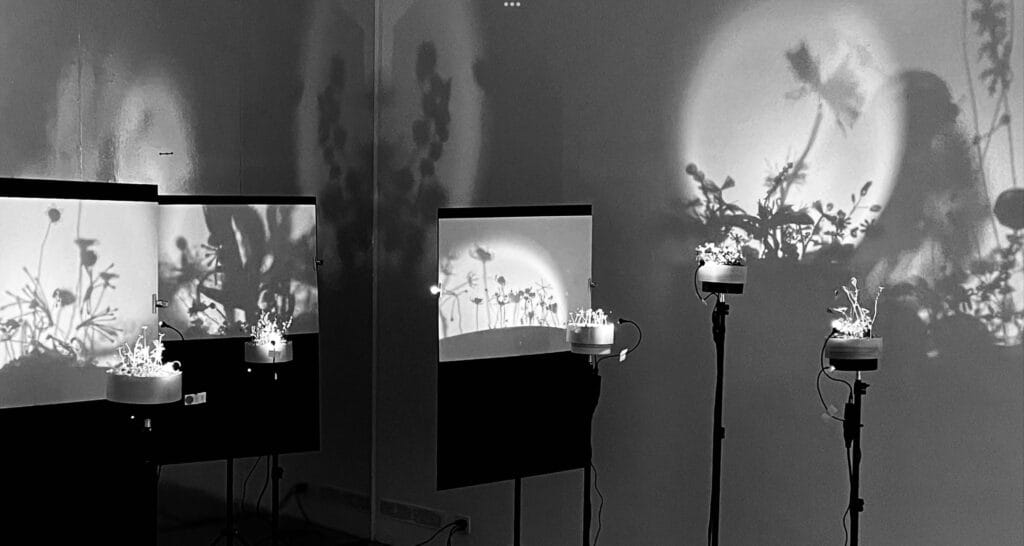
This musical experience resonates with the installation of Thessy Schoenholzer Nichols, curator, conservator, and exhibition designer, whose specialization in medieval and Renaissance burial garments as well as textile history and material culture reflects a profound scholarly depth. In her work, miniature gardens and plants are placed in an artistic context and brought to life through light. Their silhouettes are projected onto the walls, turning into the breath of music. Thus emerges a unique atmosphere — a sounding garden (Klanggarten), where nature and sound merge into a single experience.
Concert and exhibition-installation here unite into one:
Hortus Conclusus unfolds as a Klanggarten — a world that dares to be untimely contemporary.
Program:
Arvo Pärt
Für Alina
Variationen zur Gesundung von Arinuschka
Fratres
Maxim Shalygin
To All in Love
To All Resurrected
Musician
Antonii Baryshevskyi, piano
Irina Gyntova, violin
Arvo Pärt
Spiegel im Spiegel
Maxim Shalygin
Kaya
Duet
Musician
Antonii Baryshevskyi, piano
Irina Gyntova, violin
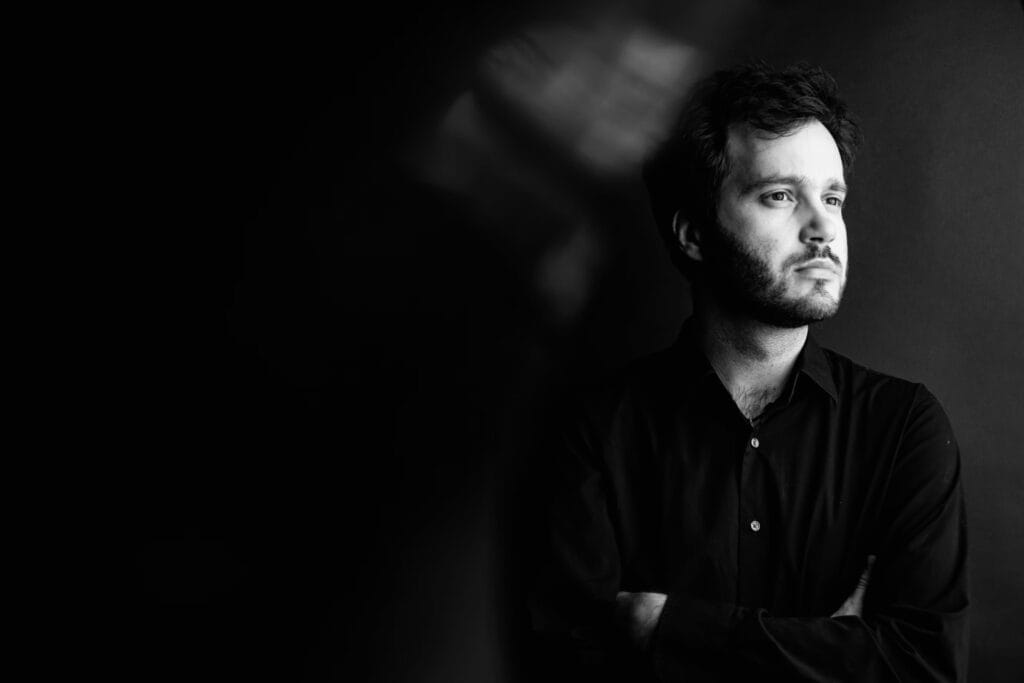
Antonii Baryshevskyi
pianist
Antonii Baryshevskyi is a Ukrainian pianist and a winner of the First Prize in some of the most prestigious international piano competitions such as Arthur Rubinstein International Piano Master Competition, “Premio Jaen”, and F. Busoni International Piano Competition.
Mr. Baryshevskyi gives master classes in Ukraine and abroad, as a guest professor in Davidsbündler Music Academy in The Hague and a regular member of the Landesakademie in Ochsenhausen (Germany).
Antonii Baryshevskyi graduated from the National Music Academy of Ukraine and École Normale de Musique de Paris where he studied with Profs. Valerii Kozlov and Marian Rybicki. He also trained under Alina Sorkina, Ryta Donskaya, Lily Dorfman.
Antonii Baryshevskyi has been a guest of renowned festivals such as Progetto Martha Argerich, Klavier Ruhr festival, Busoni Festival, projects by Musica Insieme Fondazione, and others.
Mr. Baryshevskyi performed at venues such as Wigmore Hall, Konzerthaus Berlin, Berliner Philharmonie, Kölner Philharmonie, The Royal Concertgebouw, Warsaw Philharmonic and Teatro Comunale di Bologna. He performed in almost all European countries, Israel, Japan, South Korea, and the USA.
Mr. Baryshevskyi played with some of the leading European orchestras, including Munich Radio Orchestra, The Israel Philharmonic Orchestra, Filarmonica Arturo Toscanini under the baton of maestros Asher Fisch, Frederic Chaslin, Howard Griffiths, Oksana Lyniv, Andrey Boreyko, Kirill Karabits, and many others.
Baryshevskyi has recorded for numerous CD labels, including Naxos as well as radio and TV productions of the Italian, Danish, Spanish, German, and many other Radio-Television agencies.

Irina Gyntova
violinist
Iryna Gintova is an ukrainian violinist. She was born on April 5, 1988 in Kyiv, the capital of Ukraine. At the age of 5 she entered Kyiv’s Special Music School named after Lysenko to study violin with Lyudmila Ovcharenko. With the great guidance of her teacher Iryna demonstrated an innate and inspired bond with the violin. In the age of 9 she wins her first competition in Zaporizhia, Ukraine. During the studying in Kyiv Iryna got a lot of success and appreciation in her country and abroad.
Ms. Gintova currently lives in Zurich, Switzerland where she was studying many years at the Zürich University of the Arts under the apprenticeship of Zakhar Bron and Ilya Gringolts.
Iryna has won numerous international violin competitions and awards. Among them are the Pierre Lantier International Competition in Paris, France (Grand Prix in 2001), the Gnesin International Competition in Moscow, Russia (2nd Prize in 2003), and the «Citta di Brescia» XI International Violin Competition in Brescia, Italy (2nd Prize in 2007). She is a winner of a student prize of Migros Culture Percentage instrumental music competition (2011, Zurich).
She has participated in lessons and masterclasses with personalities such as Igor Ozim, Petru Muntianu, Mihaela Martin, Menahem Pressler, Lawrence Power, Bruno Canino, Cuarteto Casals, Ivan Monighetti etc.
Ms. Gintova performs regulary solo and chamber recitals in the major concert halls of Ukraine, Russia, Switzerland, Germany, Italy, France, Czech Republic and USA. She is a founder of the string trio «Opus 8» which was created in 2009 in Zürich.
Iryna was taking part in festivals like «Gidon Kremer’s chamber music festival in Lockenhaus» (Austria, 2002), «Herbst in der Helferei» (Switzerland, 2009), «October with great violinist» (Italy 2009), Jeunesses Musicales International Chamber Music Campus for Ensembles (Germany, 2010), «Four seasons»(Switzerland, 2011), «Encuentro de música y academia de Santander» (Spain, 2012, 2013).
Since 2013 Iryna Gintova is co-leader in Sinfonieorchester St.Gallen, Switzerland.

Thessy Schoenholzer Nichols
curator, conservator, and exhibition designer
Thessy Schoenholzer Nichols was born in Basel. She worked at the Costume Institute of the Metropolitan Museum of Art, the Museum of the City of New York, and other American museums.
In Italy, she served as curator, conservator, and exhibition designer at the Galleria del Costume, Palazzo Pitti in Florence, the Palazzo Braschi in Rome, and the Museo della Moda in Gorizia. She has also taught design and textile history at various universities. Among her mentors and teachers are Diane Freeland, Kisten Aschengreen Piacenti, Janet Arnold, Santina Levey, Martin Kamer, and Noémi Speiser. Her research focuses on medieval and Renaissance burial garments as well as historical lace. She also works as a haute couture embroiderer and creates her own pieces using bobbin lace and other textile techniques.
In the exhibition, Schoenholzer Nichols presents a series of miniature gardens dedicated to nature beyond the Hortus Conclusus. In these small gardens, tiny plants and flowers thrive in “mixed media” convent works. Each of her gardens tells its own story, transforming everyday observations into new realities through a wide variety of materials. These miniature gardens form the basis of a space-encompassing light installation. They are projected onto the wall as silhouettes, creating a poetic and magical atmosphere
Hortus Conclusus
Hortus Conclusus is the Latin term for “enclosed garden,” which was often used in art and literature from the Middle Ages to the Renaissance as a symbolic garden representing the purity and protection of the Virgin Mary.
The culture of gardening is ancient. Since earliest times, humans have cultivated plants for food and medicine. The garden is not only a vital place for survival, but the cultivation of plants in aesthetic perfection has also been an important part of many different cultures. Colors, forms, scents, sounds, and textures play a central role in the Hortus Conclusus. Magnificent flowers, perfect fruits, and healing herbs grow there, all nourished by clean, clear water. It is a paradise in miniature.
Those who owned a garden during the Corona pandemic of 2020–21 know how much they enjoyed retreating to this place of peace and beauty. In times of political, economic, and health-related uncertainty, the luxury of having one’s own garden is increasingly appreciated. Garden centers, community gardens, and related online platforms are booming.